
Single-phase vs three-phase: what is the difference?
Electrical basics
Knowing how single-phase and three-phase supplies differ is what lets you pick the right inverter, the right connection point and avoid phase imbalance when installing solar. This guide compares both with animated waveforms and explains which configuration suits homes and plants.
In this guide
01
What single-phase and three-phase supply mean
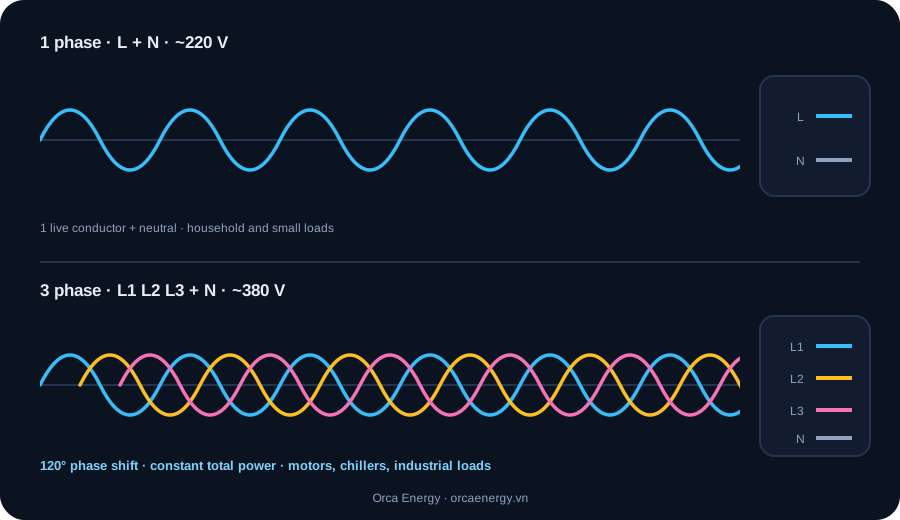
A single-phase supply has one live conductor (L) and a neutral (N); its voltage waveform is a single sine wave. In Vietnam the nominal low-voltage single-phase value is 220 V at 50 Hz.
A three-phase supply has three live conductors L1, L2 and L3 offset by 120 degrees, usually with a neutral. On Vietnam's low-voltage network the nominal line-to-line voltage is 380 V, while each phase to neutral remains 220 V.
02
Key differences at a glance
| Criterion | Single-phase | Three-phase |
|---|---|---|
| Conductors | 1 live + neutral | 3 live + neutral (plus earth) |
| Nominal voltage (Vietnam LV) | 220 V | 380 V line-to-line, 220 V phase-to-neutral |
| Typical capacity | Usually below about 10 kW | Tens of kW up to MW scale |
| Power characteristic | Instantaneous power pulsates with the sine wave | Phases complement each other, total power is steady |
| Typical equipment | Appliances, residential air-conditioning, small offices | Motors, compressors, chillers, production lines |
| Solar system | Single-phase inverter, small scale | Three-phase inverter, commercial rooftop and utility scale |
Manufacturing sites almost always use three-phase supply: three-phase motors start smoothly, run more efficiently and need smaller conductors for the same power.
03
Choosing a single-phase or three-phase inverter
The rule is simple: the inverter must match the supply at the connection point. A single-phase site takes a single-phase inverter; a three-phase site takes a three-phase inverter. Pushing a large single-phase inverter onto a three-phase board creates imbalance, heats the neutral and may breach connection requirements.
- Residential systems below roughly 5–6 kWp: a single-phase inverter is usually the cost-effective choice.
- Systems above roughly 10 kWp, or any site already on three-phase supply: use three-phase inverters for natural balance.
- Commercial rooftops from hundreds of kWp to several MWp: multiple three-phase string inverters grouped by roof area for easier O&M.
- If outage ride-through matters, choose a three-phase hybrid inverter with a backup port and pair it with a BESS.
04
Phase imbalance, load balancing and connection notes
- Imbalance appears when generation or load is unevenly spread across the phases, raising neutral current and causing local voltage deviation.
- Three-phase inverters export symmetrically by default; with multiple single-phase inverters you must distribute them evenly across phases.
- Export-limitation devices must measure all three phases, otherwise the system can still feed back on a lightly loaded phase.
- Connection point, cable sizing, switchgear and protection must be rated for the actual short-circuit level and system capacity.
Connection documentation and agreement with the utility must follow the regulations in force before energisation.
05
When should a business upgrade to three-phase?
- When total load exceeds what the existing single-phase service can deliver, or voltage sags whenever large equipment starts.
- When planning a solar system well beyond the sensible limit of single-phase inverters.
- When commissioning motors, compressors, chillers or high-power EV charging.
- When preparing the site for battery storage or future participation in direct power purchase.
Frequently asked questions
What is the three-phase voltage in Vietnam?
The low-voltage three-phase network is nominally 380 V line-to-line and 220 V between any phase and neutral, at 50 Hz.
Can a single-phase property install solar?
Yes. A single-phase system uses a single-phase inverter and suits smaller sizes, typically below about 5–6 kWp. For larger capacity, consider upgrading to a three-phase service.
Can I use a single-phase inverter on a three-phase plant?
It is not advisable. Injecting significant power into one phase creates imbalance, raises neutral current and may fail connection requirements. Use three-phase inverters, or distribute small single-phase units evenly across all three phases.
Does a three-phase solar system save more money?
Savings depend on self-consumed energy and the applicable tariff, not on the number of phases. Three-phase sites can simply host larger systems and usually have industrial daytime load, so the absolute saving is larger.
Related guides
Working principle
How does solar power work?
Animated explanation of how solar power is generated: the photovoltaic effect inside the cell, DC current from the modules, the inverter converting DC to grid-synchronous AC, how energy reaches on-site loads and the grid, and what drives real yield.
Equipment selection
Which solar brand should you choose?
How to select solar equipment brands on verifiable criteria: IEC certification, efficiency, warranty terms, degradation and local service. Why Orca Energy favours JA Solar modules and Sungrow inverters on commercial rooftop projects in Vietnam.
Solar knowledge
Commercial rooftop solar in Vietnam: rules and delivery
A complete guide to industrial rooftop solar in Vietnam: self-production and self-consumption rules under Decree 58/2025/ND-CP, sizing against the load curve, realistic yields and the EPC delivery process.
EPC services
Solar EPC: scope of work and how to select a contractor
What a solar EPC contractor delivers: the E–P–C scope, the process from survey to commissioning and O&M, selection criteria and the contract risks that matter most.
Sources
- Vietnam Electricity (EVN)
- IEC – international standards for electrical equipment
- Ministry of Industry and Trade (moit.gov.vn)
- Decree 58/2025/ND-CP on renewable energy development – National legal database
This guide compiles reference information from legal documents and official sources; it is not legal advice. Technical and financial ranges are industry reference values — project decisions require a site-specific survey.
Need a solar plan for your plant?
Orca Energy surveys the roof, analyses the load profile, simulates yield and builds the financial case for all three routes: self-investment, ESCO and renewable purchase through DPPA.
0867 831 368•solar@orcaenergy.vn
Request a consultation