
Which solar brand should you choose?
Equipment selection
The quality of a 25-year solar asset comes down to three things: equipment, design and who honours the warranty. This guide sets out selection criteria you can verify from datasheets, and explains why Orca Energy favours JA Solar modules and Sungrow inverters on commercial rooftop projects in Vietnam.
In this guide
01
Module criteria: read the datasheet, not the brochure
Every claim about a module must appear in the manufacturer's datasheet and warranty terms. These are the parameters to compare across brands before deciding.
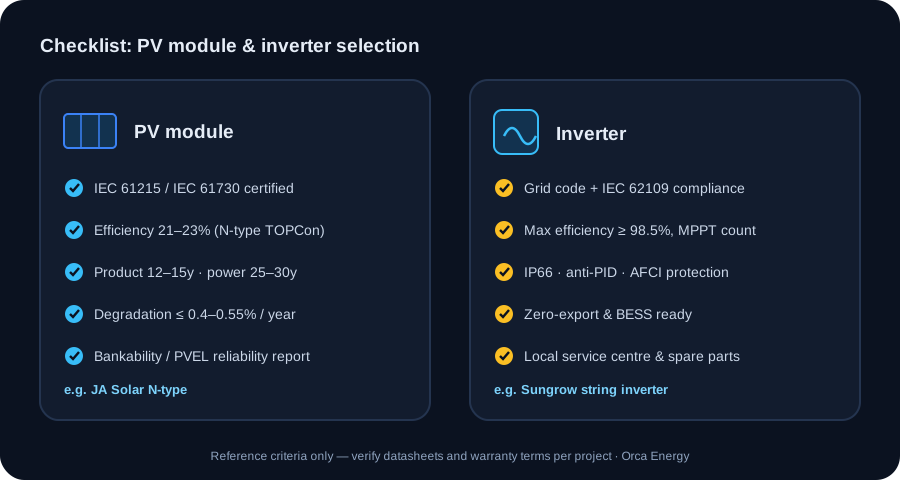
- IEC 61215 (performance) and IEC 61730 (safety) certification with valid test reports.
- Cell technology and module efficiency: N-type TOPCon lines currently outperform PERC at the same size.
- Product and performance warranty: check the term, first-year degradation and annual degradation guaranteed.
- Power temperature coefficient — the smaller the better in Vietnam's hot climate.
- Wind and mechanical load ratings, plus salt-mist corrosion class for coastal sites.
- Manufacturer bankability and third-party reliability testing, such as the PVEL scorecard.
02
Inverter criteria: the component that decides uptime
- Compliance with IEC 62109 safety standards and the utility's connection requirements.
- Peak and European efficiency, MPPT count and voltage window matched to the string design.
- IP65/IP66 protection, operating temperature range and derating behaviour in heat.
- Protection features: AFCI arc-fault detection, leakage monitoring, export limitation, reactive power control.
- Expandability: BESS-ready, open communication protocols and integration with the monitoring platform.
- Service network and spare-parts stock in Vietnam — this drives how fast a fault is cleared.
Great modules behind an inverter with no local support still lose energy every time you wait for a replacement; assess after-sales service, not just equipment price.
03
Why Orca Energy favours JA Solar modules
JA Solar is a global PV module manufacturer offering monocrystalline PERC and N-type module lines according to information published on its official website. On commercial rooftops Orca Energy favours the N-type lines for their balance of efficiency, temperature coefficient and warranty terms.
- A broad module portfolio by power class and size, which helps optimise layouts on cluttered factory roofs.
- Long product and performance warranty terms as published by the manufacturer — always check the version applicable to the batch supplied.
- Available supply and distribution channels in Vietnam, shortening procurement lead times on EPC projects.
Specifications and warranty terms are quoted from manufacturer-published documents; project contracts must attach the datasheet of the exact model and batch delivered.
04
Why Orca Energy favours Sungrow inverters
Sungrow is a global inverter and energy storage supplier whose portfolio, as published on its official website, covers string inverters for commercial and industrial projects, floating PV solutions and storage systems.
- A wide three-phase string inverter range that suits factory roofs split across areas and orientations.
- Support for export limitation and the power control functions required when a system may only self-consume.
- A monitoring ecosystem and storage compatibility, useful when the business later adds a BESS.
- Technical and service presence in the Vietnamese market, which shortens fault resolution on operating systems.
Orca Energy is not an exclusive dealer for any brand; the final equipment list follows each project's technical requirements, budget and warranty terms.
05
How Orca Energy finalises an equipment list
- Step 1 – Fix the constraints: roof load, area, orientation, daytime load profile and export limitation requirements.
- Step 2 – Build 2–3 equipment options and simulate yield in PVsyst for each rather than comparing on paper.
- Step 3 – Compare lifecycle cost: equipment price, expected yield, O&M cost and replacement risk.
- Step 4 – Verify certificates, warranty terms and the manufacturer's technical support capability in Vietnam.
- Step 5 – Lock the list and record the exact models and serial numbers in the EPC contract and handover file.
Frequently asked questions
Which solar panel brand is the best?
There is no single answer for every project. The right approach is to compare datasheets on the same criteria: IEC certification, efficiency, temperature coefficient, guaranteed degradation, warranty term and service capability in Vietnam. For commercial rooftops Orca Energy usually proposes JA Solar N-type modules with Sungrow inverters.
Modules or inverter — where should a tight budget go?
Both matter, differently: modules determine long-term yield and are hard to replace, while the inverter determines uptime and is usually replaced at least once over the project life. Do not downgrade module quality to cut upfront cost.
What does a 25-year module warranty actually cover?
Manufacturers normally split it into a product warranty (material and workmanship) and a performance warranty (guaranteed remaining output each year). Read the first-year degradation, annual degradation and the claim procedure before signing.
Are cheap unbranded products acceptable?
The risk is that certification, real efficiency and the ability to honour a warranty years later cannot be verified. For a 20–25 year business asset with ESG reporting obligations, choose fully certified equipment from suppliers present in Vietnam.
Related guides
Working principle
How does solar power work?
Animated explanation of how solar power is generated: the photovoltaic effect inside the cell, DC current from the modules, the inverter converting DC to grid-synchronous AC, how energy reaches on-site loads and the grid, and what drives real yield.
Electrical basics
Single-phase vs three-phase: what is the difference?
Animated comparison of single-phase and three-phase supply: 220 V versus 380 V in Vietnam, conductor count, suitable capacity, how to choose a single- or three-phase inverter, and phase imbalance issues when connecting solar.
EPC services
Solar EPC: scope of work and how to select a contractor
What a solar EPC contractor delivers: the E–P–C scope, the process from survey to commissioning and O&M, selection criteria and the contract risks that matter most.
Investment analysis
Solar investment cost and how to calculate payback
The cost structure of a rooftop solar project, what moves the cost per kWp, and how to calculate payback and levelised cost of electricity (LCOE) from simulated yield and grid tariffs.
Sources
- JA Solar – official manufacturer website
- Sungrow – official manufacturer website
- PVEL – PV Module Reliability Scorecard
- IEC – international standards for electrical equipment
- IEA – Solar PV
This guide compiles reference information from legal documents and official sources; it is not legal advice. Technical and financial ranges are industry reference values — project decisions require a site-specific survey.
Need a solar plan for your plant?
Orca Energy surveys the roof, analyses the load profile, simulates yield and builds the financial case for all three routes: self-investment, ESCO and renewable purchase through DPPA.
0867 831 368•solar@orcaenergy.vn
Request a consultation