
How does solar power work?
Working principle
A solar system turns light into electricity in three steps: photovoltaic cells generate direct current (DC), the inverter converts DC into alternating current (AC) synchronised with the grid, and the energy then feeds on-site loads or is exported. This guide uses animated diagrams to walk through each step and the factors that determine real-world yield.
In this guide
01
Step 1 – The photovoltaic effect inside the cell
A solar module is built from silicon cells with two semiconductor layers: an n-type layer with surplus electrons and a p-type layer with electron vacancies, meeting at the p-n junction. When a photon with sufficient energy hits the cell, it frees an electron and creates an electron-hole pair.
The built-in electric field at the junction pushes electrons one way and holes the other, producing a voltage across the terminals. Connect the terminals through an external circuit and the electrons flow — that current is the photovoltaic effect at work.
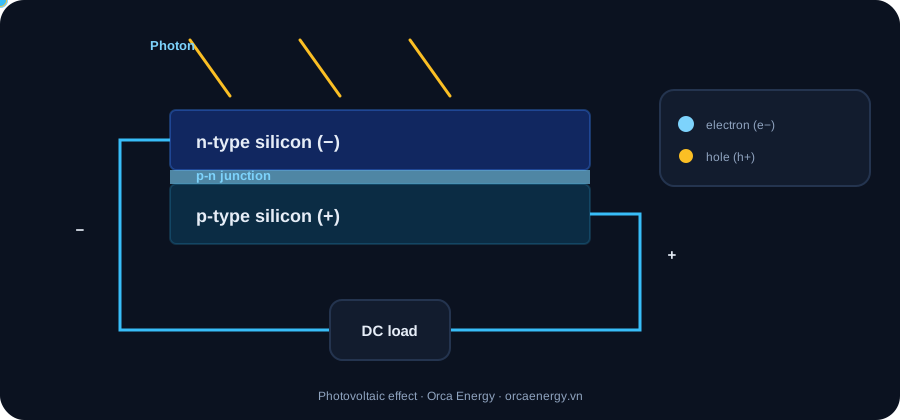
- A standard silicon cell produces roughly 0.6–0.7 V open-circuit, so many cells are wired in series inside one module.
- Current output is roughly proportional to the irradiance reaching the module surface.
- Voltage falls as cell temperature rises, so the same module delivers less power on a hot, still day than at standard test conditions.
02
Step 2 – From module DC to grid AC through the inverter
Modules are wired in series into strings to raise DC voltage before reaching the inverter. The inverter does two critical jobs: maximum power point tracking (MPPT) so each string always delivers as much power as the current conditions allow, and inversion of DC into a sine-wave AC output synchronised with the grid in frequency (50 Hz), voltage and phase angle.
AC output then passes through the distribution board and meter and supplies the plant's loads. Any shortfall is drawn from the grid; any surplus is exported, unless the system is configured for zero export.
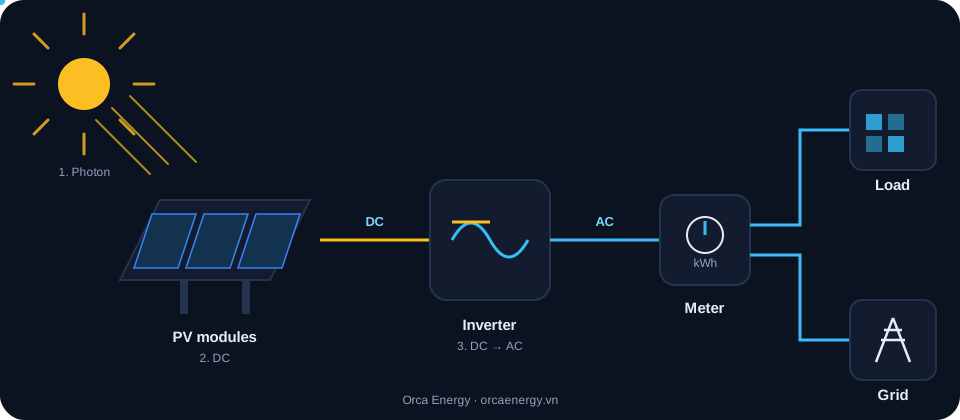
- String inverters: the standard choice for commercial rooftops, each unit managing several independent MPPTs.
- Central inverters: used on utility-scale solar farms and floating PV projects.
- Optimisers or micro-inverters: useful where the roof has local shading or several orientations.
- Zero-export control caps inverter output so nothing is fed back when the system is licensed for self-consumption only.
03
Step 3 – What a complete solar system contains
- Modules and mounting structure, engineered for wind load and roof structure.
- DC combiner with fuses, surge protection and isolators for safe maintenance.
- Inverter, AC panel, main breaker and residual current protection.
- Metering, export-limitation device and current sensors at the connection point.
- Remote monitoring that logs yield per minute/hour and raises string or inverter alarms.
- Optionally a BESS to shift midday generation into other hours.
A standard grid-tied system disconnects during a grid outage (anti-islanding) to protect line workers; keeping loads alive requires a hybrid configuration with storage.
04
What determines real-world yield
Two projects with identical installed capacity can produce noticeably different energy. The main drivers are local irradiance, roof orientation and tilt, operating temperature, shading, soiling and electrical design quality.
- Irradiance: check the project coordinates on the Global Solar Atlas before fixing the design.
- Orientation and tilt: south-facing roofs give the highest annual yield in Vietnam; east-west layouts spread output across the day.
- Temperature: module output falls with the temperature coefficient (typically around −0.3%/°C), so ventilation under the array matters.
- Shading and soiling: partial shade can drag down a whole string if string design is poor.
- System losses: cabling, connections, transformer, inverter efficiency and maintenance downtime.
05
Three configurations: grid-tied, hybrid and off-grid
| Criterion | Grid-tied | Hybrid (with storage) | Off-grid |
|---|---|---|---|
| Principle | Self-consumption, grid covers the shortfall | Self-consumption, battery charging, can run during outages | Relies on PV and batteries only |
| During a grid outage | Disconnects for safety | Keeps priority loads running | Operates normally |
| Capital cost | Lowest per kWp | Higher because of the BESS | Highest, must cover the full load |
| Best suited to | Plants, warehouses and buildings with daytime load | Sites needing outage ride-through or time-of-use arbitrage | Islands, telecom sites, areas without a grid |
Frequently asked questions
Does solar generate on cloudy days?
Yes, but output tracks irradiance. On heavily overcast days yield is a fraction of a clear day, and at night the system produces nothing — loads are then served by the grid or by storage.
Why does a solar system need an inverter?
Modules only produce direct current while plant equipment and the grid run on alternating current. The inverter converts DC into grid-synchronous AC while tracking the maximum power point, providing leakage and export protection and feeding the monitoring system.
Will solar keep working during a blackout?
A standard grid-tied system shuts down to protect utility crews. To keep loads running you need a hybrid configuration with storage and an appropriate transfer arrangement.
How much energy does 1 kWp produce per year?
In Vietnam the industry reference range is roughly 1,100–1,400 kWh per kWp per year, higher in the south and south-central regions. Project figures must come from a simulation using the actual irradiance, orientation and equipment.
Related guides
Electrical basics
Single-phase vs three-phase: what is the difference?
Animated comparison of single-phase and three-phase supply: 220 V versus 380 V in Vietnam, conductor count, suitable capacity, how to choose a single- or three-phase inverter, and phase imbalance issues when connecting solar.
Equipment selection
Which solar brand should you choose?
How to select solar equipment brands on verifiable criteria: IEC certification, efficiency, warranty terms, degradation and local service. Why Orca Energy favours JA Solar modules and Sungrow inverters on commercial rooftop projects in Vietnam.
Solar knowledge
Commercial rooftop solar in Vietnam: rules and delivery
A complete guide to industrial rooftop solar in Vietnam: self-production and self-consumption rules under Decree 58/2025/ND-CP, sizing against the load curve, realistic yields and the EPC delivery process.
Investment analysis
Solar investment cost and how to calculate payback
The cost structure of a rooftop solar project, what moves the cost per kWp, and how to calculate payback and levelised cost of electricity (LCOE) from simulated yield and grid tariffs.
Sources
- NREL – Photovoltaic research
- IEA – Solar PV
- Global Solar Atlas – World Bank Group
- IEC – international standards for electrical equipment
- Vietnam Electricity (EVN)
This guide compiles reference information from legal documents and official sources; it is not legal advice. Technical and financial ranges are industry reference values — project decisions require a site-specific survey.
Need a solar plan for your plant?
Orca Energy surveys the roof, analyses the load profile, simulates yield and builds the financial case for all three routes: self-investment, ESCO and renewable purchase through DPPA.
0867 831 368•solar@orcaenergy.vn
Request a consultation