
Rooftop solar policy in Vietnam: Directive 10/CT-TTg and MOIT guidance
Policy
Self-production, self-consumption rooftop solar is now part of Vietnam's national electricity saving programme: Directive 10/CT-TTg sets saving targets and annual installation ratios, and the Ministry of Industry and Trade issued Official Letter 7404/BCT-DL urging provinces to implement it. This guide summarises the key points published on moit.gov.vn and what they mean for industrial users.
In this guide
01
Saving targets and installation ratios in Directive 10/CT-TTg
According to information published by MOIT, the directive links electricity saving with self-production, self-consumption rooftop solar combined with suitable storage, so power is supplied locally and the grid gains flexibility.
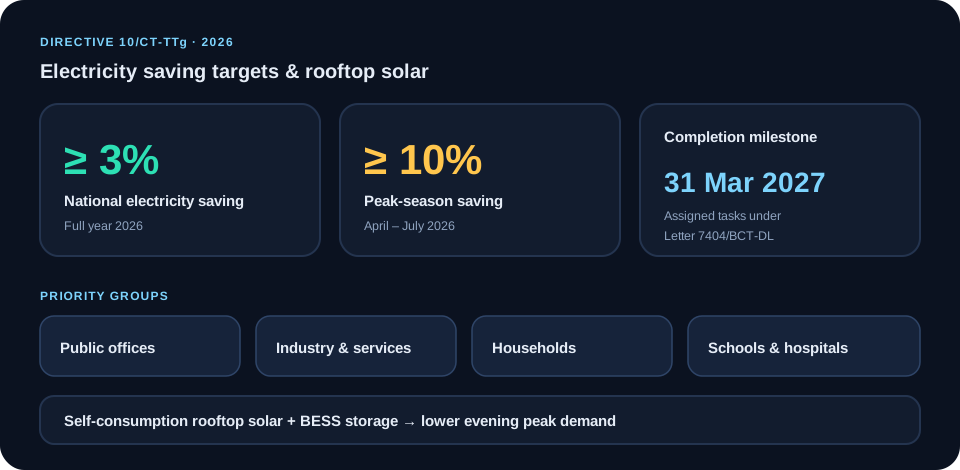
- Save at least 3% of total national electricity consumption in 2026.
- Save at least 10% during the peak months from April to July.
- Priority groups: public offices, production, business and service facilities, and households.
- Rooftop solar combined with battery energy storage (BESS) is encouraged.
- Direction of roughly 10% of public offices and 10% of households installing each year, or 20% of planned rooftop capacity over 2026–2030.
These figures are policy management targets stated in the directive as published by MOIT, not guaranteed output or financial incentives for any individual project.
02
Official Letter 7404/BCT-DL: MOIT pushes provinces to act
MOIT issued Official Letter 7404/BCT-DL urging provinces to develop self-production, self-consumption rooftop solar, including allocating investment plans and funding for public offices, schools and hospitals.
- Provinces prepare investment plans and budget for installations at offices, schools and hospitals.
- Tasks assigned under Directive 10/CT-TTg are to be completed before 31 March 2027.
- Provincial people's councils are asked to consider support policies for households.
- EVN coordinates initial grid connection checks and ongoing compliance under Decree 58/2025/ND-CP.
03
What this means for factories and commercial buildings
For a business, the practical value is not a cash incentive but a clearer legal framework and more proactive local utilities guiding connection and operation of self-consumption systems.
- Procedures are handled more consistently under Decree 58/2025/ND-CP, reducing schedule risk from paperwork.
- The policy direction favours on-site consumption and limits export, so capacity must match daytime load.
- Storage is encouraged, which suits plants with load shifted away from solar hours or peak demand charges.
- Companies whose renewable demand exceeds available roof area can also look at the DPPA mechanism.
04
What to prepare in 2026
- Review building legal records: construction permit, roof condition, fire safety documentation.
- Measure and analyse daytime load to size capacity without unwanted export.
- Check metering limits and the connection voltage level before fixing system size.
- Decide the financing route: self-investment, roof lease or a zero-capex ESCO model.
- Plan emissions reporting if ESG, RE100 or supply-chain requirements apply.
Frequently asked questions
Does Directive 10/CT-TTg oblige companies to install rooftop solar?
As published by MOIT, the directive sets electricity saving targets and annual installation directions and assigns tasks to state agencies and provinces. For private companies it is an encouragement rather than a general obligation; specific duties depend on the legislation applicable to each entity.
Who does the 31 March 2027 deadline apply to?
According to moit.gov.vn, it is the completion deadline for tasks assigned under Directive 10/CT-TTg that MOIT is urging provinces to fulfil, including installation plans for public offices, schools and hospitals.
Is there financial support for companies installing solar?
The support measures discussed so far focus on public offices and households, and the household support policy is still at draft stage. Companies should base project economics on actual electricity savings rather than assumed subsidies.
Should we wait for clearer rules before installing?
Self-production, self-consumption systems already have a legal framework under Decree 58/2025/ND-CP, amended and supplemented by Decree 243/2026/ND-CP, so most corporate projects do not need to wait. What matters is verifying connection requirements and sizing capacity to the load.
Related guides
Procedure
Rooftop solar procedure under Decree 58/2025 in Vietnam
How to install self-production, self-consumption rooftop solar in Vietnam under Decree 58/2025/ND-CP: building conditions, notification versus development registration, grid connection and the rules on surplus electricity.
Policy
Support for households installing rooftop solar and storage
What is already in force under Decree 58/2025 for household self-consumption rooftop solar, what remains a draft decision at MOIT, and how a household should calculate real savings.
Solar knowledge
Commercial rooftop solar in Vietnam: rules and delivery
A complete guide to industrial rooftop solar in Vietnam: self-production and self-consumption rules under Decree 58/2025/ND-CP, sizing against the load curve, realistic yields and the EPC delivery process.
Energy storage
BESS for industrial users: applications and sizing
What BESS does in a factory: peak shaving, shifting solar generation, backup during outages and supporting power purchase contracts. How to size power and energy, choose cell technology and meet safety requirements.
Sources
- MOIT: Directive 10/CT-TTg on strengthening electricity saving and rooftop solar development
- MOIT urges provinces to develop rooftop solar (Official Letter 7404/BCT-DL)
- MOIT: EVNNPC promotes electricity saving through rooftop solar development
- Decree 58/2025/ND-CP on renewable energy development – Vietnam national legal database
- Decree 243/2026/ND-CP amending Decrees 57/2025/ND-CP and 58/2025/ND-CP – Government Portal
This guide compiles reference information from legal documents and official sources; it is not legal advice. Technical and financial ranges are industry reference values — project decisions require a site-specific survey.
Need a solar plan for your plant?
Orca Energy surveys the roof, analyses the load profile, simulates yield and builds the financial case for all three routes: self-investment, ESCO and renewable purchase through DPPA.
0867 831 368•solar@orcaenergy.vn
Request a consultation