
Rooftop solar procedure under Decree 58/2025 in Vietnam
Procedure
Decree 58/2025/ND-CP details provisions of the Electricity Law on renewable energy development and includes a dedicated chapter on self-production, self-consumption rooftop solar; Decree 243/2026/ND-CP later amended parts of it. This guide summarises the sequence based on guidance published by MOIT.
In this guide
01
Building conditions before installation
According to MOIT guidance at implementation conferences, the host building must have valid construction legal status; adding a rooftop system must not conflict with the building records and must maintain structural, electrical and fire safety.
- Legally built structure with a roof — or a house-like structure — able to carry the array.
- System capacity matched to on-site electricity demand.
- Respect the voltage level and current limits of existing metering equipment.
- Electrical safety, lightning protection and fire safety documents updated for the added scope.
Decree 243/2026/ND-CP widened the scope to systems installed on structures shaped like a house, not only on roofs of conventional buildings.
02
Notification or development registration: pick the right route
Depending on capacity and whether the system connects to the grid or exports, it may only require a notification or may need development registration with the competent authority. Identify this at design stage because it drives the schedule.
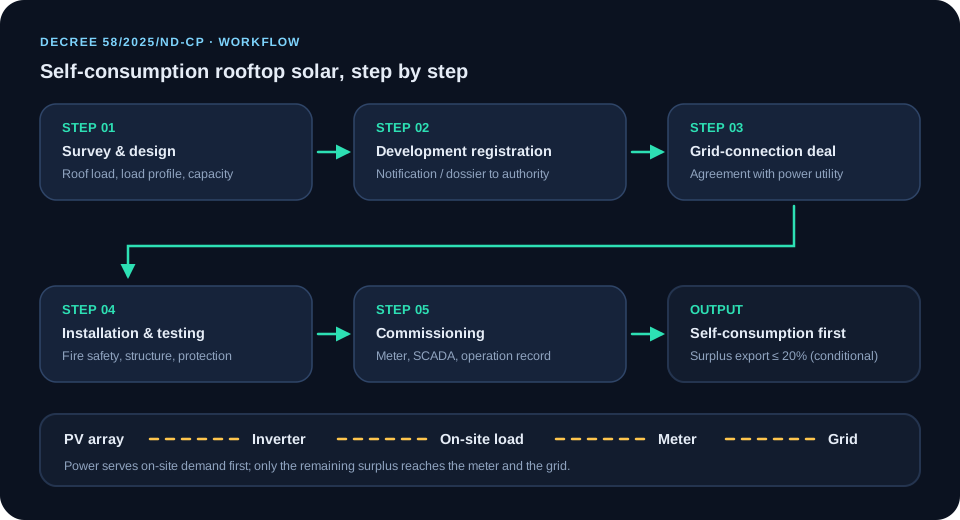
- Step 1 – Survey the roof, measure load, set capacity and decide whether any export is allowed.
- Step 2 – Determine the applicable route (notification or development registration) by capacity and connection mode.
- Step 3 – Contact the local power utility for connection and operating guidance.
- Step 4 – Build, test, commission and complete operating documentation.
- Step 5 – Archive legal records, acceptance reports and generation data for later reporting.
Exact capacity thresholds and document lists depend on the legislation and on local utility guidance; verify them before starting.
03
Surplus electricity and export limits
The policy direction prioritises on-site consumption and limits export. At the implementation event in Bac Ninh, a MOIT representative stated that self-production, self-consumption systems may sell surplus electricity up to 20% of generated output under the applicable rules.
- Non-exporting systems typically use zero-export devices and load-following control.
- Systems selling surplus must agree terms with the power utility and stay within the regulated limit.
- Adding storage absorbs surplus instead of exporting it, which suits plants with shifted load.
The 20% figure follows statements and guidance published on moit.gov.vn; conditions, pricing and procedures for surplus purchase follow the applicable regulations and are not an Orca Energy commitment.
04
What typically delays approval
- Sizing capacity above on-site demand, creating export that is not permitted.
- Ignoring limits of the existing meter and connection voltage level.
- Construction and fire safety records not updated for the rooftop addition.
- Missing equipment documentation (certificates, inverter data) in the first submission.
- Discovering only during construction that development registration was required.
Frequently asked questions
Does a factory rooftop system need a permit?
Depending on capacity and connection mode, it may require only a notification or a development registration under Decree 58/2025/ND-CP. In all cases construction, electrical safety and fire safety rules apply, and the local utility must be involved whenever the system connects to the grid.
Can surplus solar be sold to EVN?
Per guidance published by MOIT, self-production, self-consumption systems may sell surplus electricity up to 20% of generated output under the applicable rules. Conditions, price and procedure depend on the legislation and the agreement with the utility.
What is zero export and when is it needed?
It is a control scheme that limits or fully blocks power flowing back to the grid, used when the system only serves on-site load or when the utility requires no export. Decree 243/2026/ND-CP added the concept of a Zero-Export device to the regulations.
How long does the process take?
It depends on the applicable route, the quality of the submission and the workload of the local utility. The most effective way to shorten it is to identify the correct route early and submit a complete technical package the first time.
Related guides
Policy
Rooftop solar policy in Vietnam: Directive 10/CT-TTg and MOIT guidance
What Directive 10/CT-TTg and Official Letter 7404/BCT-DL say about electricity saving and self-production, self-consumption rooftop solar: targets, priority groups, deadlines and what it means for factories.
Permitting
Grid connection for rooftop solar: process and documents
The connection agreement process for self-consumption rooftop solar with the Vietnamese utility: preparation steps, the technical documents to have ready, commissioning, and the mistakes that get applications sent back.
Grid connection engineering
What is zero export, and when should a factory use it?
How zero export (export limitation) works on self-consumption rooftop solar: control principle, required equipment, the yield you trade away, and when zero export beats registering surplus export.
Solar knowledge
Commercial rooftop solar in Vietnam: rules and delivery
A complete guide to industrial rooftop solar in Vietnam: self-production and self-consumption rules under Decree 58/2025/ND-CP, sizing against the load curve, realistic yields and the EPC delivery process.
Sources
- Decree 58/2025/ND-CP on renewable energy development – Vietnam national legal database
- Decree 243/2026/ND-CP amending Decrees 57/2025/ND-CP and 58/2025/ND-CP – Government Portal
- MOIT works with Bac Ninh on self-production, self-consumption rooftop solar
- MOIT: Directive 10/CT-TTg on strengthening electricity saving and rooftop solar development
- Vietnam Electricity (EVN)
This guide compiles reference information from legal documents and official sources; it is not legal advice. Technical and financial ranges are industry reference values — project decisions require a site-specific survey.
Need a solar plan for your plant?
Orca Energy surveys the roof, analyses the load profile, simulates yield and builds the financial case for all three routes: self-investment, ESCO and renewable purchase through DPPA.
0867 831 368•solar@orcaenergy.vn
Request a consultation