
Support for households installing rooftop solar and storage
Policy
Alongside public offices and companies, households are a priority group in Vietnam's self-production, self-consumption rooftop solar programme. This guide separates what is already in force from what is still a draft, so households can size the investment on reliable data.
In this guide
01
What is already in force
Decree 58/2025/ND-CP contains a dedicated chapter on self-production, self-consumption rooftop solar that also applies to households, prioritising on-site use and encouraging storage. Decree 243/2026/ND-CP later amended related provisions.
- Household self-consumption systems are encouraged, with priority on using the energy locally.
- Installing battery storage and automatic control equipment is encouraged.
- Per moit.gov.vn, measures such as green credit or import duty exemptions for equipment may apply under the relevant rules.
02
Still a draft: the household support decision
MOIT has drafted and submitted for appraisal a decision on support policy for households installing self-production, self-consumption rooftop solar and storage systems. The support levels in that draft are indicative only until the document is issued.
- The draft proposes preferential loans through the Vietnam Bank for Social Policies of up to VND 40 million per household.
- Within that cap, the PV portion and the storage portion are treated separately by capacity and energy.
- The draft also mentions support from local budgets after the system is installed and operating.
- One target stated in the draft material concerns the share of offices and homes using self-consumption rooftop solar by 2030.
This is draft content published by MOIT for consultation and appraisal, not regulation in force. Households should not treat these loan or support levels as certain when deciding to invest.
03
How to calculate household economics
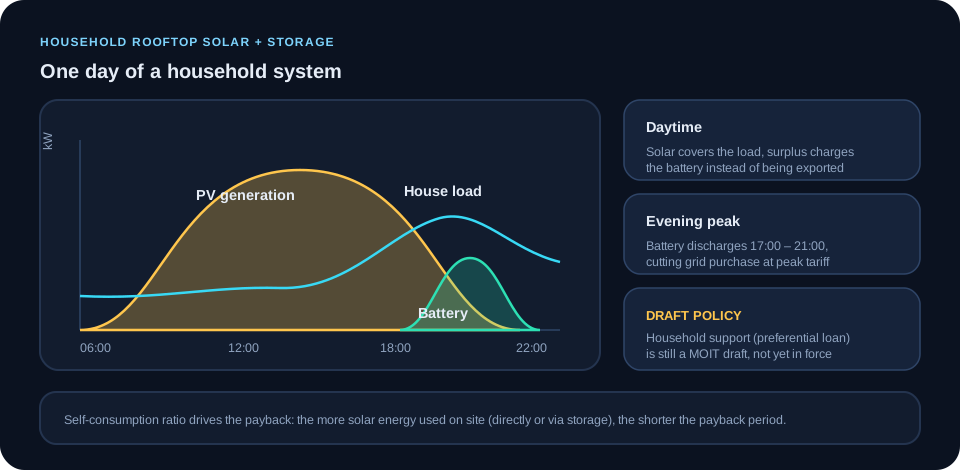
Household economics depend almost entirely on the self-consumption ratio: energy used during sunshine hours replaces electricity billed at the applicable tiered tariff, while surplus without storage is worth far less.
- 3–5 kWp is the common range for a detached home, needing roughly 6 m² of roof per kWp.
- Shift large loads (washing machine, water pump, air conditioning) into sunshine hours to lift self-consumption.
- Storage enables evening use but raises capex; install it when evening bills are high or outages are frequent.
- With tiered residential tariffs, the savings are largest when the top tiers are cut first.
04
Checks before signing an installation contract
- Verify roof structure and waterproofing at every penetration.
- Require explicit equipment data: module and inverter models, battery capacity, warranty terms.
- Confirm the installer handles utility paperwork and hands over as-built documentation.
- Do not rely on absolute output guarantees; output varies with irradiation, orientation and shading.
- If storage may be added later, choose an inverter and switchboard that allow expansion.
Frequently asked questions
Can households already borrow VND 40 million for rooftop solar?
The VND 40 million cap through the Vietnam Bank for Social Policies appears in the draft decision MOIT submitted for appraisal; it is not regulation in force at the time of writing. Watch for the official document when issued.
What paperwork does a household need?
Household self-consumption systems follow Decree 58/2025/ND-CP; depending on capacity and whether the system connects or exports, either a notification or a development registration applies. The local power utility provides connection guidance.
Is home battery storage worth it?
Check the bill: if most consumption is in the evening or outages are frequent, storage has value; if daytime load is already high, maximise self-consumption first and add storage later. Storage significantly increases upfront cost.
Can a narrow townhouse roof work?
Yes, but capacity is limited by usable area and shading from neighbouring buildings; plan around 6 m² per kWp. On very small roofs the benefit comes from cutting the highest tariff tiers rather than from total output.
Related guides
Policy
Rooftop solar policy in Vietnam: Directive 10/CT-TTg and MOIT guidance
What Directive 10/CT-TTg and Official Letter 7404/BCT-DL say about electricity saving and self-production, self-consumption rooftop solar: targets, priority groups, deadlines and what it means for factories.
Procedure
Rooftop solar procedure under Decree 58/2025 in Vietnam
How to install self-production, self-consumption rooftop solar in Vietnam under Decree 58/2025/ND-CP: building conditions, notification versus development registration, grid connection and the rules on surplus electricity.
Investment analysis
Solar investment cost and how to calculate payback
The cost structure of a rooftop solar project, what moves the cost per kWp, and how to calculate payback and levelised cost of electricity (LCOE) from simulated yield and grid tariffs.
Energy storage
BESS for industrial users: applications and sizing
What BESS does in a factory: peak shaving, shifting solar generation, backup during outages and supporting power purchase contracts. How to size power and energy, choose cell technology and meet safety requirements.
Sources
- MOIT submits for appraisal the draft support policy for household rooftop solar
- Decree 58/2025/ND-CP on renewable energy development – Vietnam national legal database
- MOIT: EVNNPC promotes electricity saving through rooftop solar development
- MOIT: Directive 10/CT-TTg on strengthening electricity saving and rooftop solar development
- Ministry of Industry and Trade (moit.gov.vn)
This guide compiles reference information from legal documents and official sources; it is not legal advice. Technical and financial ranges are industry reference values — project decisions require a site-specific survey.
Need a solar plan for your plant?
Orca Energy surveys the roof, analyses the load profile, simulates yield and builds the financial case for all three routes: self-investment, ESCO and renewable purchase through DPPA.
0867 831 368•solar@orcaenergy.vn
Request a consultation